Not long after I began graduate school in the early 2000s, I began to see the ways that many people—friends, family, even my own colleagues—have a fundamental misunderstanding about what it means to be an academic. From my perspective, these misunderstandings come in two flavors. The first is that professors really only work for the few hours a week they are physically in a classroom (for which they are paid too well), are left-wing fanatics bent on indoctrinating their students, and spend a majority of their time in wood-paneled rooms sitting in perfectly broken-in leather chairs. The second is that professors are “called” to serve their students and their institutions, are available for work at all hours and on all days, and should be putting words on paper in every moment that they aren’t actually teaching a class.
Similarly, golf is a sport that suffers from contrasting negative assumptions. The first, and perhaps most serious, is the belief that golf is for the wealthy and elite. This is the most serious because it is grounded in the truth of American golf for the last 100 years, with its emphasis on private clubs and their racist and sexist practices. And while there have been improvements on this front thanks to Tiger Woods’ emergence in the late 1990s, outreach and teaching programs like First Tee, and recent perspective-shifting media companies like No Laying Up, the often-uncomfortable reality is that golf is an expensive sport. The other is that golf is superfluous, pointless, or, as Mark Twain (in)famously said, “a good walk spoiled.”
I am both a professor and a golfer, and while I understand the genesis of all of these assumptions it bothers me that both my career and my hobby are hemmed in by misunderstanding on all sides. Being a professor is great but it’s also just a job, and it is subject to many of the same drawbacks and annoyances as pretty much any other profession. And golf does have a questionable history and problems with economics (so does, ahem, America), but it can also be a place of reflection, meditation, exercise, and joy.
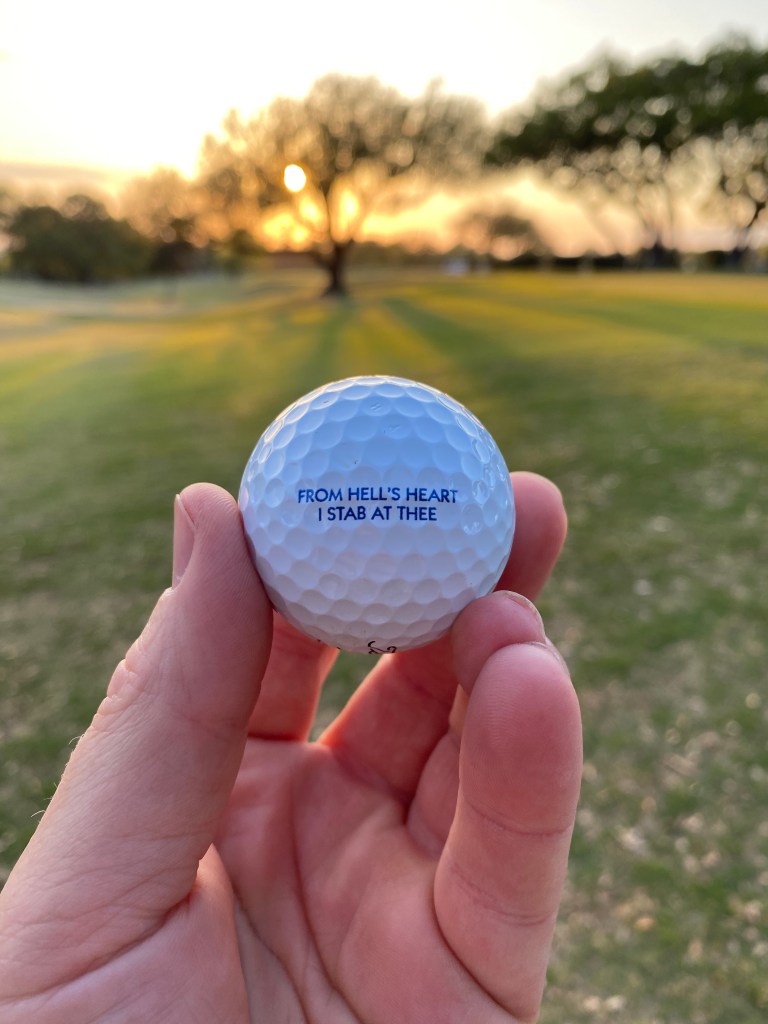
I am at a place of transition in my life, and I have started to see many parallels and sympathies between me as a professor and me as a golfer. I have been fairly successful in both: I am currently tenured at a high-profile D1 university, and I have gotten my handicap index down to a 4.1 (which put me in the top 10% of all male golfers who carry an official handicap). But lately I’ve been in a bit of a slump, as has most of the COVID-affected world. At work I am coming off of the worst semester I have had in the 10+ years I’ve been at my current institution, and my career outlook has undergone a fairly significant shift because of it. Without getting into the weeds of that now, I went from having a fairly significant administrative position to going back to being purely faculty, which means my teaching and research expectations have increased. In golf I’ve seen my handicap slowly balloon from a 4.1 to a 6.0, and while I haven’t hit the dreaded “soft-cap” yet, going from consistently shooting in the mid- to upper-70s to rarely breaking 80 is demoralizing. It is only a couple shots on the scorecard, but the canyon between 79 and and 81 is grand.
So it’s time to refocus and commit myself to achieving two goals: 1) promotion from associate to full professor, and 2) getting my handicap index below 3. In order to achieve goal 1, I need to return to writing. Writing is a skill that rots as it lies fallow, and during my time as an administrator my writing ability has gone to seed. I haven’t lost it entirely—I even have an article on fishermen in Puritan sermons coming out in the journal Early American Studies soon—but I need to get back into better form.
In order to achieve goal 2, I also need to fine tune some things. Carrying a 6 index means that I can still get myself around the golf course, but I need to focus on those things that really matter for scoring: putting, short game, and avoiding the big numbers. My last few rounds have been in the low 80s but included multiple double bogies thanks to errant tee shots that found the red (hazard) or—gasp—white (out of bounds) stakes.
This project will document my progress towards both goals, and will work to dispel some of those errant notions about academia and golf. Writing here will be practice for my book, and talking about being a professor who plays golf will—I hope—keep me focused on improving myself in both worlds.
So drop in, read and learn along with me, and join me on this journey.
 Par for the Course